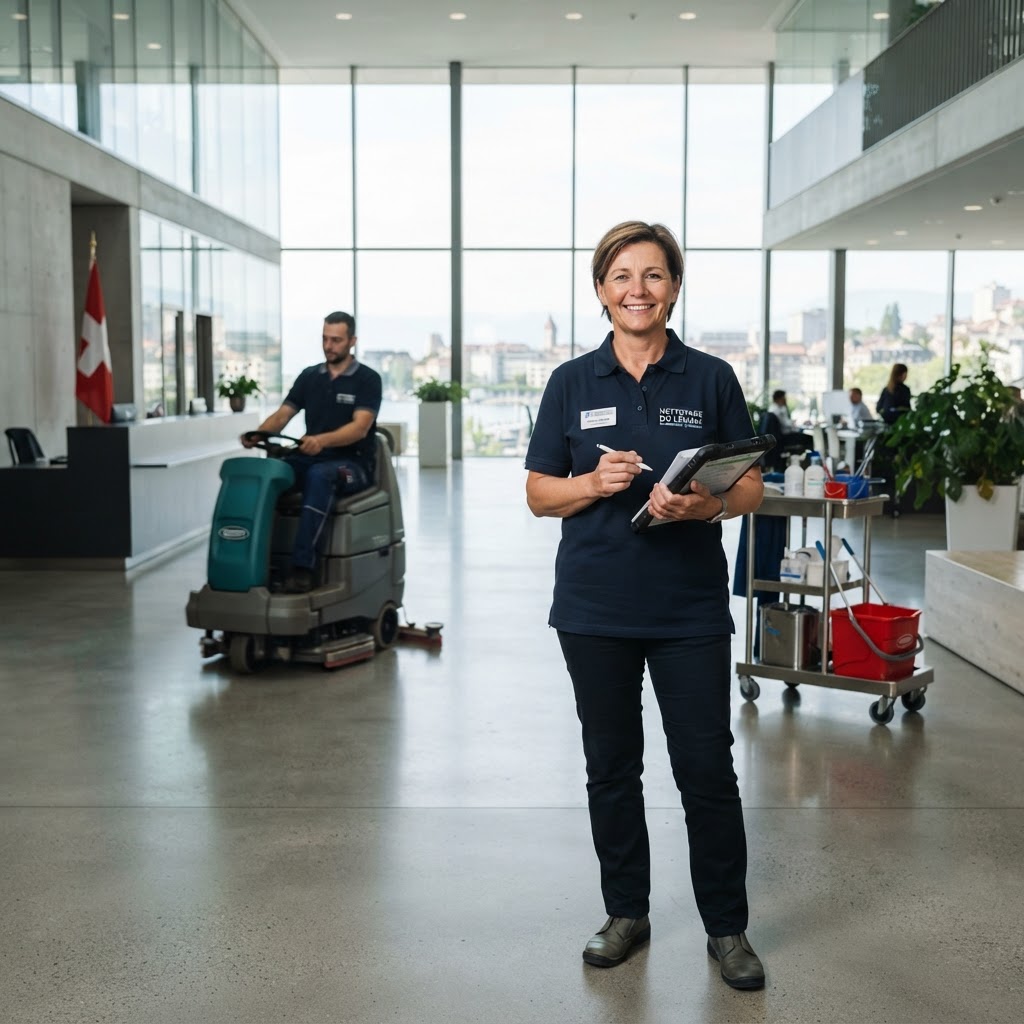
Selling a Cleaning or Facility Management SME in French-speaking Switzerland: What Makes a Successful Transfer
Selling a cleaning or facility management company is not about selling equipment: the value lies in your recurring maintenance contracts, your teams and the trust of your clients. Here are the specifics you need to know to approach the sale of your company in French-speaking Switzerland with confidence, and why a direct buyer makes the process simpler.
Why a cleaning or facility management company changes hands differently
A cleaning or facility management SME in French-speaking Switzerland has a sale profile that is radically different from that of a traditional industrial or trading company. Its value does not rest on patents, inventory or sophisticated machinery, but on three fundamental pillars: recurring contracts, field teams and the trust of clients. This reality has a profound influence on how such a company must be prepared and presented during a business transfer.
With net margins often between 3% and 8%, the business is by nature labour-intensive and sensitive to the slightest variation in productivity. An experienced buyer knows this: they are not buying assets, they are buying a human organisation capable of delivering a daily service that is reliable and compliant with contractual requirements. This is precisely what makes the transfer of this type of company both delicate and structured.
To learn more about the specifics shared by all service companies, we invite you to read our article on selling a B2B services SME.
Maintenance contracts and recurring revenue
The contract portfolio is the heart of a cleaning company's value. Contracts signed with property management firms, condominium associations (PPE), offices, industrial sites or healthcare facilities generate predictable revenue, month after month. This recurrence is highly valuable in the eyes of a buyer.
Before any transfer, it is essential to analyse the following elements for each significant contract:
- Remaining term: a contract expiring in three months is worth far less than a renewable multi-year contract.
- Historical renewal rate: a portfolio that has been stable for five years is more reassuring than one with rapid turnover.
- Termination clauses: notice periods, possible penalties, conditions for early exit.
- Change-of-control clauses: particularly sensitive in a share deal, where some contracts may provide for automatic termination if the shares are sold.
A careful review of the contracts ahead of the transfer avoids surprises at the time of the acquisition and secures the value being transferred.
Workforce and the collective labour agreement
The cleaning sector in Switzerland is governed by a collective labour agreement (CLA) specific to the cleaning industry, and compliance with it determines the company's good standing and the trust of the social partners. Any sale involves a rigorous check of compliance with salary conditions, job classifications and training obligations.
SMEs in this sector frequently employ a large number of part-time staff, sometimes several dozen, with split shifts and complex rounds. This profile raises several issues during a transfer:
- The automatic transfer of employment relationships under Article 333 of the Swiss Code of Obligations (CO) in the event of a transfer of the business or of a business unit.
- The high turnover of cleaning staff, which can weaken operational continuity.
- The retention of team leaders and area managers, the true linchpins of the organisation, whose departure during the transition can directly affect service quality.
An attentive buyer will seek to understand how the company retains its field supervisors, and whether that loyalty rests solely on the personal relationship with the current owner-manager.
Dependence on the owner-manager and client relationships
In many French-speaking Swiss cleaning SMEs, the owner-manager is at once the salesperson, the complaints handler and the trusted contact for property managers, letting agents or facility managers. This centralisation is understandable in a human-sized structure, but it represents a real risk for the buyer.
The key questions to ask before the sale:
- Who prices the offers and quotes today? Is this skill documented and transferable?
- Do the main clients have an exclusive relationship with the owner-manager, or are they attached to the company as such?
- Is there an operational second-in-command capable of ensuring continuity during the transition period?
The transferability of commercial relationships is one of the first criteria examined by any serious buyer. To understand what an acquirer is really looking for, read what a buyer really looks for in an SME.
Client concentration and tenders
A frequent risk in service SMEs: the top five clients sometimes account for 60% to 80% of revenue. Such concentration weakens the valuation and can deter a cautious buyer.
Furthermore, some contracts — particularly in the public sector (municipalities, care homes, hospitals, cantonal administrations) — are subject to periodic tender procedures. These re-tenders introduce a structural uncertainty that the seller must document honestly:
- How frequently are the key contracts put out to tender?
- What is the renewal track record on these contracts?
- Does the company have a demonstrable competitive advantage (certifications, price, quality, length of the relationship)?
A diversified portfolio, with a significant proportion of multi-year private contracts, is perceived as considerably more robust.
Equipment, vehicles and products
Unlike other sectors, a cleaning SME has a limited but functional fleet of equipment: scrubber-dryers, single-disc machines, professional vacuum cleaners, window or facade cleaning equipment, service vehicles. These assets must be carefully inventoried before the sale.
Points to clarify:
- Ownership or leasing: leased or hire-purchase equipment creates financial commitments to be taken over or settled.
- Condition and age: an ageing fleet implies short-term investment that the buyer will factor into their valuation.
- Stocks of products and consumables: their valuation must be included in the negotiation of the sale price.
Although secondary in the overall valuation, these elements can give rise to discussions during the due diligence phase. Anticipating how they will be handled, notably through warranties and indemnities, is a wise precaution.
Margins, normalised EBITDA and productivity
The valuation of a cleaning SME rests essentially on normalised EBITDA, that is, EBITDA adjusted for exceptional items, non-recurring owner remuneration and atypical expenses. In a sector with tight margins, every point of profitability counts.
The operational indicators that directly influence profitability:
- Output per m²: number of square metres cleaned per hour worked, a key productivity indicator.
- Round planning: an efficient organisation reduces idle time and improves margins.
- Absenteeism: a high rate generates replacement costs and expensive overtime.
- Subcontracting: its share of revenue and its impact on margins must be clearly identified.
- Price pressure: the sector is highly competitive, with clients who regularly negotiate prices downwards. The evolution of pricing over three to five years is an important signal.
Seasonality is generally limited in this sector, which is a positive point. On the other hand, price pressure and the difficulty of passing on the wage increases imposed by the CLA are realities that every seller must document transparently.
Preparing the transfer and the direct-buyer approach
A successful transfer is ideally prepared twelve to twenty-four months before the actual sale. This leaves time to put in place the elements that reassure a buyer and to correct any weaknesses identified.
What to put in order before the sale
- Clean, up-to-date accounts: balance sheets for the last three financial years, detailed income statements, a clear separation between personal and business expenses.
- Written, signed contracts: any verbal agreement must be formalised. A verbal contract is worth nothing in a sale file.
- A clear operational organisation chart: who does what, and what the roles of each area manager or team leader are.
- An identified operational second-in-command: capable of managing day-to-day operations without the constant involvement of the owner-manager.
- An up-to-date client list: with revenue per client, frequency of service, type of services and remaining contract term.
Why deal with a direct buyer
Vendre-Entreprise.ch directly acquires cleaning and facility management SMEs in French-speaking Switzerland, with no intermediary and no public listing. In concrete terms, this means:
- A single point of contact from the first conversation through to signing.
- Total confidentiality: your employees, your clients and your competitors are not informed of the process.
- A letter of intent (LOI) delivered within 72 hours of receiving the basic financial information.
- A smooth, supported transition: the handover period is defined according to your needs, with no abrupt break.
Are you the owner of a cleaning or facility management SME and thinking about your succession? Start by getting an initial indication of value with the valuation simulator, or get in touch directly for a confidential, no-obligation conversation.
Disclaimer: The information contained in this article is provided for informational and educational purposes only. It does not constitute legal, tax or financial advice. Any decision relating to the sale of your company should be made in consultation with a qualified lawyer, notary or tax adviser, depending on your personal situation and the structure of your company.
On the same topic
- Selling a Joinery, Carpentry or Interior Fit-Out SME in French-speaking Switzerland: Keys to a Successful Transfer
- Selling a Car Dealership, Garage or Body Shop in French-speaking Switzerland: Keys to a Successful Transfer
- Selling an Electrical Installation SME in French-speaking Switzerland: What Makes a Successful Transfer
Your sector, your market, your business: let's talk. We acquire healthy SMEs in French-speaking Switzerland directly, with no intermediary.
Let's talk about your SME