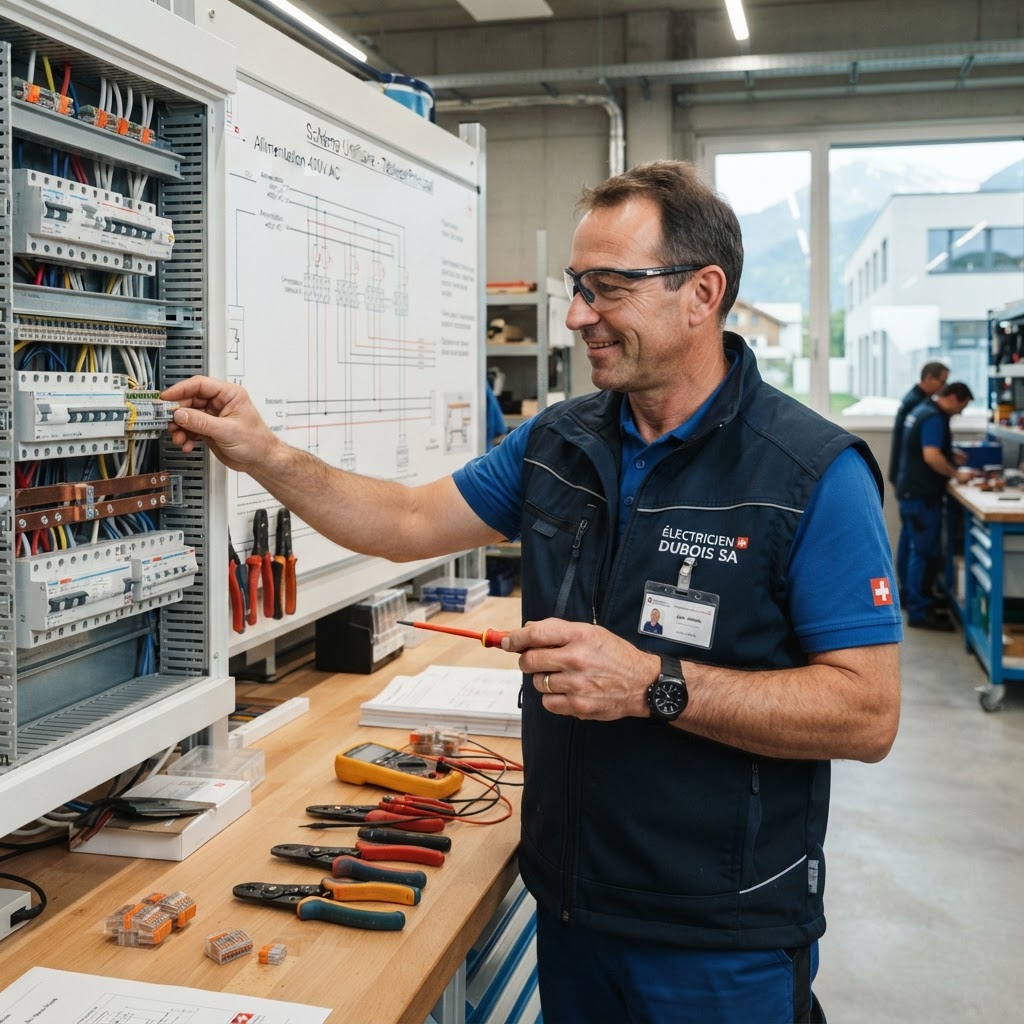
Selling an Electrical Installation SME in French-speaking Switzerland: What Makes a Successful Transfer
Selling an electrical installation SME in French-speaking Switzerland follows very specific rules: the REC licence, the order book, qualified teams, dependence on the owner-manager and the energy transition weigh as heavily as the numbers. Here are the specifics you need to know to approach the sale of your electrical business with confidence, and why a direct buyer simplifies the process.
Selling an electrical SME in French-speaking Switzerland: a process with very specific stakes
Do you run an electrical installation business in French-speaking Switzerland and are you thinking about handing over the reins? Whether you are preparing for retirement, seizing an opportunity or simply turning a page, the transfer of an electrical SME is unlike any other business sale.
Between the regulatory requirements specific to the sector, the value of your qualified teams, your order book and the challenges of the energy transition, the parameters you need to master go well beyond simple financial indicators. Here is what every business owner in the electrical sector should know before starting a sale process.
The REC licence: the cornerstone of any business transfer
In Switzerland, working as an electrical installer requires an authorisation issued by the Federal Inspectorate for Heavy Current Installations (ESTI). This authorisation — commonly known as the REC licence (Responsable des travaux électriques et du contrôle, i.e. person responsible for electrical work and inspection) — is personal. It is attached to an individual, not to the company itself.
This is one of the first obstacles in a poorly anticipated transfer: if the owner-manager is the holder of the REC licence and leaves without having planned the succession of this role, the company can no longer legally operate.
What this means in practice for the sale
- The buyer must either hold a REC licence themselves or rely on a qualified employee within the acquired company.
- If no employee holds the required qualifications, the buyer will have to hire a technical manager before the sale is completed.
- The handover between two licence holders must be coordinated with ESTI, which takes time.
- In some cases, a transition period with the seller may be required or strongly recommended.
A professional buyer already active in the electrical sector knows these constraints and can anticipate them effectively — a considerable advantage over an external buyer new to the trade.
The order book and maintenance contracts: the real intangible asset
In an electrical SME, value does not lie solely in tools, vehicles or stocks of materials. It lies above all in two intangible assets that are often underestimated in a standard valuation:
- The order book of current and upcoming projects: contracts signed with property developers, municipalities, property managers or industrial clients provide visibility on future revenue. This is a key indicator for the buyer.
- Recurring service and maintenance contracts: a portfolio of loyal clients with annual maintenance mandates is a source of stable, predictable income, which is particularly prized in a business valuation.
For the seller, it is therefore essential to document and formalise these assets before entering negotiations. A verbal agreement or a relationship based on personal trust with a client carries little weight in a due diligence.
How to add value to these elements before the sale
- Convert tacit agreements into signed written contracts.
- Classify projects by stage of completion and residual value.
- Draw up a complete list of recurring clients with the average annual amounts invoiced.
- Identify clients tied to you personally and prepare a strategy for transferring the relationship.
Qualified teams: a human asset that is hard to replace
The labour market for electrical trades is tight in French-speaking Switzerland. Qualified electricians, site foremen and automation technicians are scarce and in high demand. A stable, competent team therefore represents considerable value for a buyer.
During a transfer, the risk of key employees leaving when a change of management is announced is real. Well-managed communication, a gradual transition and guarantees of stability for employees are decisive factors in the success of a sale.
Best practices for securing human capital
- Inform key employees at the right time, neither too early nor too late.
- Involve the buyer in a handover period so that they become known to and recognised by the team.
- Put continuity forward as the central value of the transfer.
- Where necessary, provide retention clauses for strategic profiles.
Dependence on the owner-manager: the number one risk factor
In many electrical SMEs in French-speaking Switzerland, the business owner is also the main salesperson, the technical reference, the project manager and sometimes even the electrician on site. This concentration of roles is often unavoidable in businesses with fewer than 20 employees — but it becomes a major risk factor during a sale.
A potential buyer will immediately ask: “What happens if the owner leaves the day after signing?” If the answer is unclear, the valuation will be revised downwards and the warranties requested will be more extensive.
How to reduce this dependence before selling
- Gradually delegate operational responsibilities to site foremen or a technical director.
- Formalise internal processes (quotes, orders, site monitoring) so that they do not rely solely on your tacit knowledge.
- Introduce the buyer to strategic clients and partners before the sale is completed.
- Plan a post-sale support period, ideally three to twelve months depending on the size of the business.
The energy transition: an opportunity to leverage
Switzerland has embarked on an ambitious transition to renewable energy. For electrical SMEs, this translates into growing demand in promising areas:
- Installation of photovoltaic panels and grid connection.
- Charging stations for electric vehicles (residential, commercial, public).
- Home automation and smart energy management in new and renovated buildings.
- Heat pumps and hybrid systems, in collaboration with plumbing and heating installers.
If your business is already positioned in these segments, it is a strong valuation argument. If not, it may be wise to start this diversification a few years before the sale to maximise its impact on the valuation.
Valuing an electrical SME: beyond the numbers
The valuation of an electrical business is based on a combination of standard methods — EBITDA multiple, net asset value, discounted cash flows — and qualitative criteria specific to the sector.
Factors that have a positive influence on the valuation
- Recurring revenue from maintenance contracts.
- An autonomous team with little dependence on the owner-manager.
- A REC licence that is transferable or available in-house.
- A positioning in energy transition trades.
- A diversified client base without over-reliance on a single principal.
- Clear accounts, audited financial statements and rigorous administrative management.
Factors that can reduce the value
- A poorly documented or highly volatile order book.
- An ageing fleet of vehicles or equipment that needs replacing.
- Heavy dependence on one or two clients accounting for more than 30% of revenue.
- Ongoing disputes or projects not yet signed off with warranty risks.
Why a direct buyer simplifies the transfer
The traditional route to a sale — appointing an intermediary, publishing a confidential advertisement, receiving multiple candidates and conducting lengthy due diligences — can take 18 to 36 months. For the owner of an electrical SME, this is a long and exhausting period of uncertainty, often incompatible with the day-to-day management of projects.
A direct, professional buyer who knows the sector offers concrete advantages:
- Speed: the purchase decision can be made within a few weeks, without a tender process.
- Understanding of the sector: no need to explain what a REC licence is or how a construction tender market works.
- Legal and financial security: a serious acquirer presents their financing capacity from the very start of discussions.
- Discretion: the sale is negotiated without public exposure, which protects your employees, your clients and your reputation.
- Guaranteed continuity: an acquirer from the sector can guarantee the continuity of the business, jobs and ongoing contractual commitments.
Preparing your business transfer: the key steps
A successful sale is ideally prepared two to three years in advance. Here are the main steps of a structured approach:
- 1. Internal audit: assess the company's strengths and weaknesses and identify the points to correct before the sale.
- 2. Preliminary valuation: obtain a realistic estimate of your company's value from a professional.
- 3. Getting the documents in order: financial statements, articles of association, employment contracts, leases, client and supplier contracts must be complete and accessible.
- 4. Reducing dependence on the owner-manager: strengthen the autonomy of the teams and formalise internal processes.
- 5. Identifying the buyer: depending on your priority (price, speed, continuity), the strategy differs.
- 6. Negotiation and due diligence: with the support of legal and tax advisers specialised in SME transfers.
- 7. Post-sale support: a well-managed transition protects the value transferred and your reputation.
Conclusion: a sale prepared with the right partners
Selling an electrical SME in French-speaking Switzerland is a demanding process, but entirely achievable when approached methodically and with foresight. The specifics of the sector — REC licence, qualified human capital, project contracts, energy issues — call for support from professionals who genuinely know your trade.
Whether you are two years away from retirement or considering a sale in the short term, the first step is always the same: talk to someone who understands your sector and can give you a clear view of the value and potential of your business.
Do not wait for the pressure of the calendar to force you to sell on poor terms. A well-prepared transfer means a business that lives on, employees who keep their jobs and an owner who leaves with peace of mind after building something that lasts.
On the same topic
- Selling a Joinery, Carpentry or Interior Fit-Out SME in French-speaking Switzerland: Keys to a Successful Transfer
- Selling a Car Dealership, Garage or Body Shop in French-speaking Switzerland: Keys to a Successful Transfer
- Selling a Cleaning or Facility Management SME in French-speaking Switzerland: What Makes a Successful Transfer
Your sector, your market, your business: let's talk. We acquire healthy SMEs in French-speaking Switzerland directly, with no intermediary.
Let's talk about your SME