Selling a Car Dealership, Garage or Body Shop in French-speaking Switzerland: Keys to a Successful Transfer
Selling a car garage or body shop is not just a matter of selling a workshop and a stock of vehicles: the brand contract, qualified staff, recurring after-sales business and the environmental compliance of the site weigh as much as the figures. Here are the specific points to know in order to approach the transfer of your company in French-speaking Switzerland with confidence, and why a direct buyer simplifies the process.
Transferring a car garage or body shop in French-speaking Switzerland is a project that deserves rigorous, specific preparation. These businesses combine distinctive characteristics — brand contracts, scarce qualified labour, vehicle stock, environmental compliance — that set them well apart from a conventional service or retail SME. This article presents the key points to master in order to approach this transfer under the best conditions.
1. Why a garage or body shop is not transferred like an ordinary SME
A car garage is not a uniform business. Under one roof, several distinct trades often coexist: new and used vehicle sales, the mechanical workshop, bodywork and paint, quick service, and sometimes the management of a tyre storage facility. Each of these activities follows its own economic logic, with very different margins, cycles and risks.
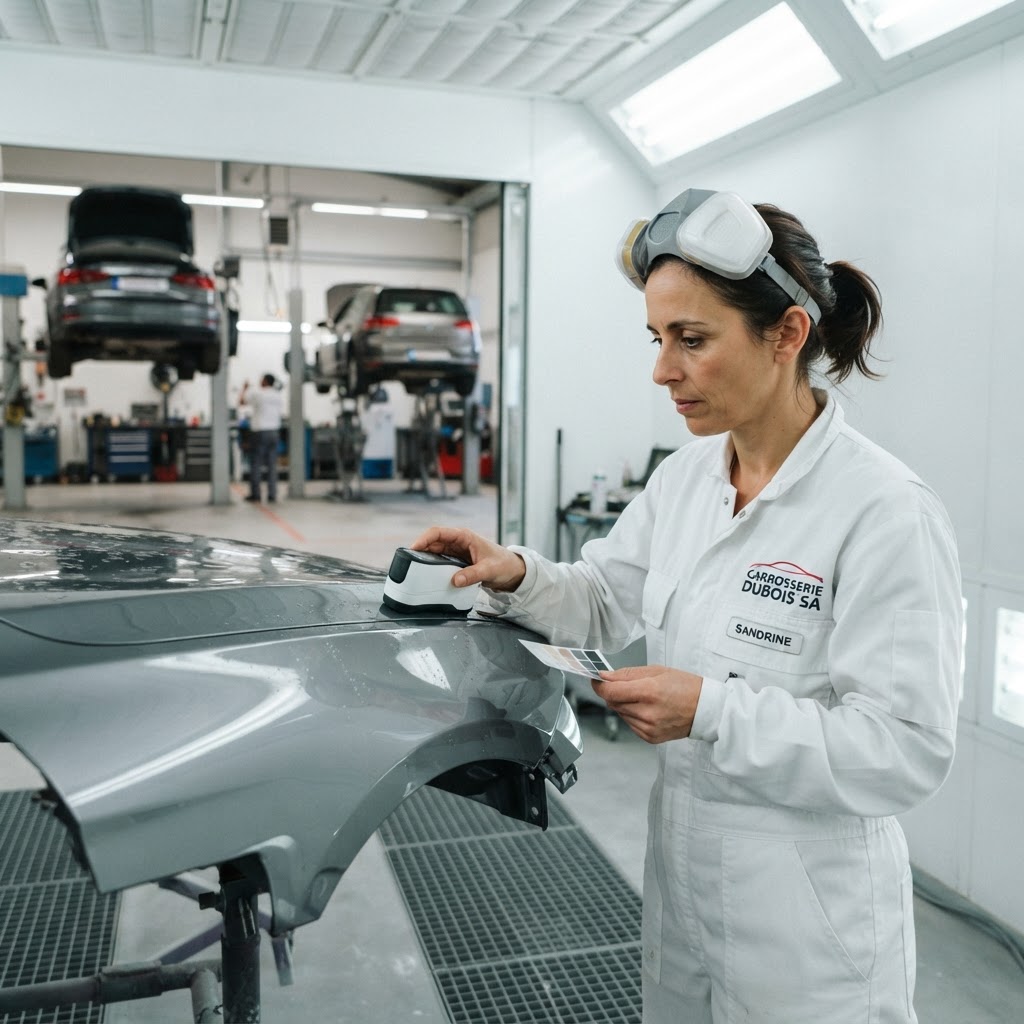
New vehicle sales, for example, often generate low gross margins and depend heavily on the volume targets imposed by the manufacturer. The after-sales workshop, by contrast, shows much higher profitability and valuable recurring business. Bodywork involves heavy investment in equipment and approvals. This interlocking makes the analysis of value both richer and more complex.
Added to this is high capital intensity: diagnostic tools, vehicle lifts, paint booth, wheel alignment rig, IT infrastructure, stocks of parts and tyres. The operating site, whether owned or rented, is often a central asset whose configuration directly determines the value of the business.
2. Dealership contract, brand approval or independent garage: the most sensitive point
If your business operates under an agent or dealership contract with a car brand, that contract was very probably concluded intuitu personae. This means it was granted in consideration of you personally, and the manufacturer or importer will in principle have to approve the buyer before any effective transfer.
A change-of-control clause may allow the grantor to terminate the contract if the buyer does not meet its criteria. Brand standards, required investments, authorised brand repairer status, specific training and high-voltage certifications are all elements the buyer will have to take on.
- Check the remaining term and renewal conditions of the dealership contract
- Identify change-of-control clauses and any pre-emption rights held by the importer
- Anticipate the buyer approval process by the manufacturer or national importer
- Document approvals, training and certifications currently in force
An independent multi-brand garage is technically simpler to transfer: there is no third-party grantor approval to obtain. On the other hand, its value rests more on its local reputation, its customer base and the quality of its team — less formalised elements, but just as decisive.
3. The workshop and qualified labour: a human asset that is hard to replace
In French-speaking Switzerland, the shortage of qualified staff in the automotive trade is a concrete reality. Automotive mechatronics technicians, panel beaters, vehicle paint sprayers, service advisers: these profiles are rare, expensive to recruit and take a long time to train.
The workshop manager and the company's second-in-command often play a central role in operational continuity. If their departure coincides with that of the seller, the acquirer faces a major risk. Retaining these key profiles, ideally formalised in suitable employment contracts, is something any serious buyer will examine closely.
The rise of hybrid and electric powertrains adds a further dimension: high-voltage certification is now essential to work on these vehicles. The team's level of qualification in this area is a real competitive advantage — or, conversely, an investment the acquirer will need to anticipate.
4. After-sales and the customer base: the real engine of profitability
A shrewd acquirer will look at after-sales long before vehicle sales volumes. What a buyer really looks for in an SME in French-speaking Switzerland is, above all, recurrence and visibility on future flows. And the mechanical workshop and periodic servicing meet exactly that criterion.
An active customer base, multi-year service contracts, a well-managed tyre hotel and a high workshop utilisation rate are all positive signals. The quality of the customer file — number of active vehicles, visit frequency, average ticket — is valuable data that should be documented and showcased.
- Number of active customers over the last 24 months
- Workshop return rate and servicing frequency
- Service and maintenance contracts in force
- Tyre hotel volume and utilisation rate
- Billed hours per technician and workshop utilisation rate
5. The body shop and dependence on principals
If your business operates a body shop, a significant share of revenue probably comes from institutional principals: insurance companies, corporate fleets, leasing companies or local referrers. These agreements are valuable, but their robustness in the event of a change of shareholder deserves in-depth analysis.
Insurer approvals are often granted to the legal entity, but may be reviewed upon a transfer. Negotiated hourly rates, turnaround times and payment terms are contractual elements to examine carefully. Excessive concentration of revenue on one or two principals is a risk factor the acquirer will factor into their analysis.
6. Vehicle stock, stock financing and warranties: potential liabilities to document
The used vehicle stock often represents several hundred thousand francs on the balance sheet. Its valuation is sensitive: a vehicle unsold for several months depreciates, and a poorly valued trade-in can quickly turn into a loss. Stock financing, where in place, is a financial commitment the acquirer will need to measure.
In addition, statutory warranties for defects under the Swiss Code of Obligations, as well as commercial warranties granted to vehicle purchasers, represent potential liabilities. These commitments survive the sale and are examined closely during the acquisition audit. To understand how this type of commitment is handled contractually, our article on warranties and indemnities in the sale of an SME: scope, duration and points of vigilance will give you useful insight.
- Detailed inventory and valuation of the used vehicle stock
- Outstanding stock financing and associated conditions
- List of commercial warranties in force and estimate of residual costs
- History of returns and warranty claims
7. Operating premises and environmental compliance
The operating site of a garage or body shop is often at the heart of the transaction. Whether owned or operated under a lease, its configuration — showroom area, workshops, paint booth, washing area — directly determines the viability of the business model.
The environmental dimension is unavoidable. A paint booth must hold all its permits in force. The oil separator must be compliant and regularly maintained. The storage of hazardous products — oils, solvents, batteries — must comply with current regulations. Special waste management must be tracked and documented.
The history of soil contamination is a particularly sensitive point. A site operated for several decades may show historic contamination whose remediation would entail significant costs. These elements are examined closely during the acquisition audit. A complete, up-to-date environmental file reassures the acquirer and smooths the process. By way of comparison, commercial property and lease issues are also central to transfers in other sectors, as shown in our article on selling a retail business in French-speaking Switzerland.
8. Preparing the transfer calmly and the direct-buyer approach
A successful transfer is prepared 12 to 24 months in advance. This timeframe makes it possible to identify weak points, correct them, and build a solid presentation file that will make the acquirer's decision easier.
Here are the elements to put in order as a priority:
- Clean accounts and normalised EBITDA: adjust the owner's remuneration to market terms, isolate private expenses and non-recurring items to present a true picture of structural profitability
- Brand contracts and leases: check their remaining term, renewal conditions and change-of-control clauses
- Organisation chart and employment contracts: clarify roles, remuneration and commitments towards key employees
- Inventory of stock and equipment: updated valuation of the vehicle stock, exhaustive list of equipment with condition and residual value
- Environmental file: paint booth permits, separator compliance, special waste register, available soil reports
At Vendre-Entreprise.ch, we are a direct buyer of SMEs in French-speaking Switzerland. We are neither a broker nor an intermediary: we examine files in our own name, with a single point of contact throughout the process. Your business is never put on the market or publicly advertised, and confidentiality is guaranteed at every stage. After analysing your file, we are able to send you a letter of intent within 72 hours. We also attach great importance to a smooth transition, supporting the seller on the terms that suit them best.
Estimate the value of your garage and let's talk in complete confidence
Are you considering transferring your car garage or body shop? Start by estimating the value of your company with our online simulator — quick, free and confidential. To go further, arrange a first confidential conversation with our team to present your situation and explore the transfer options together.
This article is for general information purposes. It does not constitute legal, tax or accounting advice and in no way replaces the advice of a qualified lawyer, notary or tax adviser. As every situation is unique, we recommend that you consult the relevant professionals before taking any decision relating to the transfer of your business.
On the same topic
- Selling a Joinery, Carpentry or Interior Fit-Out SME in French-speaking Switzerland: Keys to a Successful Transfer
- Selling an Electrical Installation SME in French-speaking Switzerland: What Makes a Successful Transfer
- Selling a Cleaning or Facility Management SME in French-speaking Switzerland: What Makes a Successful Transfer
Your sector, your market, your business: let's talk. We acquire healthy SMEs in French-speaking Switzerland directly, with no intermediary.
Let's talk about your SME