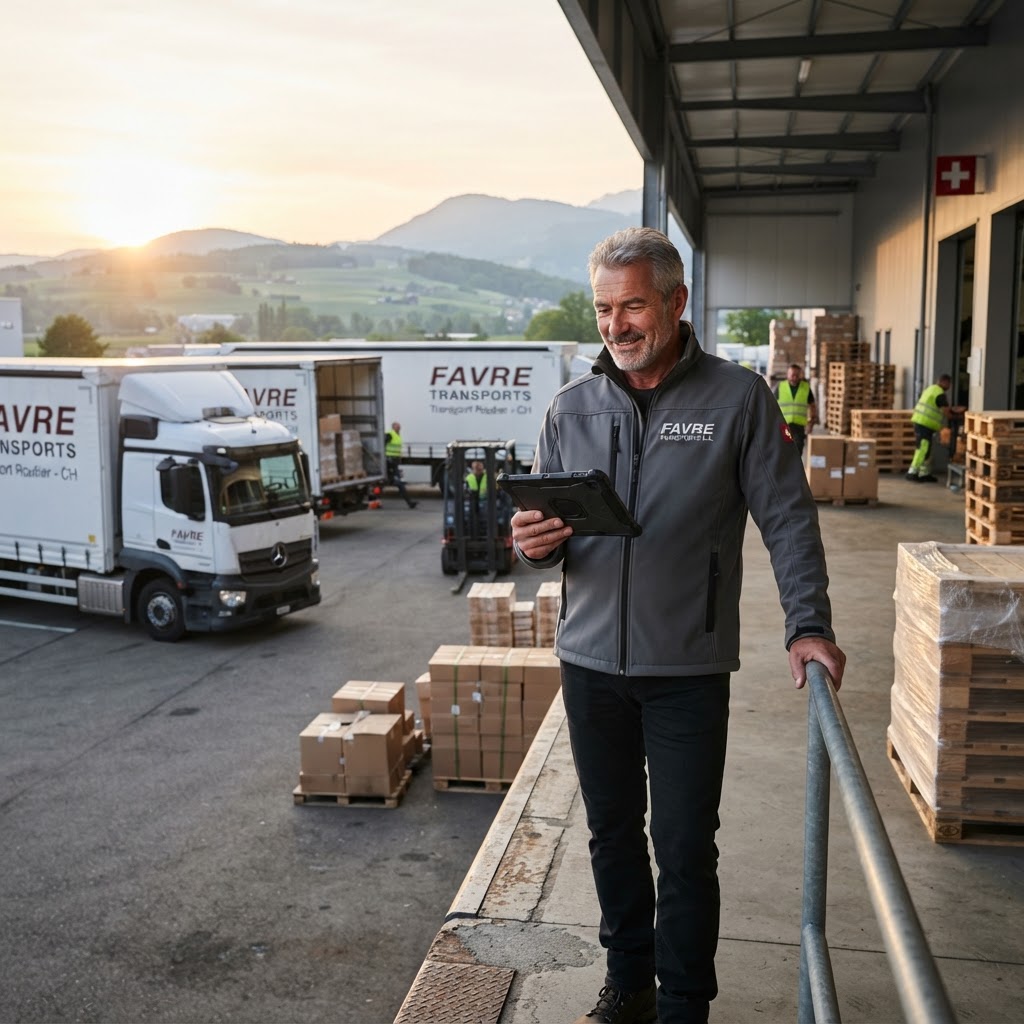
Selling a Transport or Logistics Company in French-speaking Switzerland: What Makes a Successful Transfer
Selling a transport or logistics company in French-speaking Switzerland follows very particular rules: the FOT licence and transport manager, the vehicle fleet, the driver shortage and client contracts weigh as heavily as the figures. Here are the specifics you need to know to approach the sale of your company with confidence, and why a direct buyer makes the process simpler.
Why transport and logistics have their own transfer rules
Selling a road haulage or logistics company in French-speaking Switzerland is not a transaction like any other. This sector combines several structural characteristics that set it radically apart from a service SME or a retail business: operating margins often below 5%, high capital intensity linked to the vehicle fleet, strong exposure to fuel price fluctuations and intense competitive pressure, particularly from European operators.
These particularities mean that any potential buyer — whether an industrial group, a competitor or a direct buyer such as Vendre-Entreprise.ch — will analyse your file through a specific lens. Understanding that lens before committing to a sale process gives you the best chance of achieving a smooth, secure transfer.
If you would first like to understand what a buyer really looks for in an SME, we invite you to read our dedicated article on the subject.
The transport licence and the transport manager: a central issue
In Switzerland, professional road haulage of goods is subject to an authorisation issued by the Federal Office of Transport (FOT). This licence rests on the designation of a transport manager, an individual who must meet three cumulative conditions:
- Good repute: no criminal convictions incompatible with the exercise of the profession.
- Financial standing: proof of sufficient equity according to the number of vehicles operated.
- Professional competence: attested by a recognised certificate (CFC examination, federal diploma or European equivalent).
In the vast majority of French-speaking Swiss transport SMEs, the designated transport manager is the founding owner-manager themselves. When that owner sells the company and steps back, the licence does not transfer automatically: a new transport manager meeting the same conditions must be designated, which can take several weeks or months.
This point is often the main blocking factor in a sale. Anticipating this issue even before entering into discussions with a buyer is therefore imperative. Identifying a qualified successor transport manager — whether an internal employee or an external profile — and gradually integrating them into operational management is a step you should ideally plan 12 to 24 months before the sale.
The vehicle fleet: key asset, potential liability
The fleet is the heart of any transport company. For a buyer, it represents both an indispensable operational asset and a short-term CAPEX (capital expenditure) risk if the vehicles are ageing or if stricter emission standards require renewal.
What the buyer will examine first
- The average age of the fleet and the mileage of the main vehicles.
- The distinction between vehicles owned outright, under operating lease or under finance lease: off-balance-sheet commitments linked to leases must be explicitly documented.
- Compliance with the Euro standards in force and the forthcoming regulatory trajectory, particularly in urban areas.
- The gap between the net book value of the vehicles in your balance sheets and their real (second-hand) market value, which can be very significant.
- The planned renewal programme and its impact on post-acquisition cash flow.
A well-maintained, documented fleet whose financial commitments are clearly identified reassures a buyer and considerably smooths the discussions.
Drivers and operational staff: your scarcest resource
The shortage of qualified drivers is a structural reality in French-speaking Switzerland. Having a stable, trained and loyal team is a major competitive advantage that every buyer values highly. Conversely, high turnover or reliance on temporary drivers represents a serious operational risk.
Staff-related points of attention
- The validity of each driver's driving licences and CPC qualifications (Certificate of Professional Competence).
- Compliance with the OTR (Ordinance on Working and Rest Hours for Professional Drivers): recurring irregularities in tachograph records can constitute a significant regulatory liability.
- Length of service and the salary conditions applicable under the sector's collective labour agreement.
- The retention of key teams after the sale: experienced drivers, dispatchers, operations managers.
Confidentiality is particularly important here. If your drivers learn prematurely that the company is for sale, you risk destabilising a team that is hard to replace. This is one of the reasons why working with a direct buyer, with no public tender and no broker network, is often the most suitable solution in this sector.
Client contracts and recurrence: the lifeblood of the business
In transport and logistics, the value of a company rests largely on the quality and durability of its client portfolio. A buyer will systematically analyse the structure of your revenue before anything else.
The questions every buyer will ask
- Are your main clients bound by multi-year framework agreements or only by ad hoc orders?
- What is the concentration of clients: if your largest client accounts for more than 30% of revenue, this is an identified risk.
- Are your contracts intuitu personae (tied to you personally) or transferable to a new owner? In an asset deal in particular, transferability must be checked contract by contract.
- What share of your business is subcontracting and chartering, and on what terms?
- Are any major tenders in progress or upcoming? Their outcome can significantly change the scope of the business.
Depots, loading bays and operating premises
The physical infrastructure of a transport company — depot, loading bay, maintenance workshop, secure parking — is often as important as the fleet itself. Whether these premises are owned or rented is decisive in the structure of a sale.
- If the premises are owned by the company, their value must be included in the overall valuation, along with the question of whether the buyer wishes to keep them within the scope of the deal or exclude them.
- If the premises are rented, the remaining term of the lease, the renewal conditions and the possibility of assigning the lease to the buyer are contractual points that must be checked.
- The geographical location — access to motorways, proximity to client industrial zones — is a real, sometimes underestimated, competitive advantage.
- The operating permits (building permits, zoning, heavy goods vehicle parking permits) must be in order and documented.
These property and regulatory aspects are also covered in our article on selling an industrial or subcontracting SME, a sector that shares several similar issues.
Margins, figures and visibility: what a buyer analyses first
Reading the financials of a transport company requires rigorous adjustment of the accounts. The reported gross EBITDA can conceal very different realities depending on accounting practices and cost structure.
The indicators scrutinised by a serious buyer
- Normalised EBITDA, after adjusting for non-market owner remuneration, rents between related parties and exceptional expenses.
- Exposure to fuel prices: what share of revenue is passed on to clients through diesel indexation clauses? In the absence of such clauses, margin volatility can be very significant.
- The seasonality of the business and the ability to maintain a sufficient fleet utilisation rate in the low season.
- The empty-running rate: an operational efficiency indicator directly correlated with profitability.
- Working capital requirement: client payment terms, often long in this sector, can create structural cash flow pressures.
The question of post-sale warranties is also central in this type of transaction. We recommend familiarising yourself with the mechanisms of warranties and indemnities, which apply fully to the sale of transport companies, particularly in the event of OTR inspections or client disputes arising after the sale.
Preparing the transfer and the direct-buyer approach
A successful sale in the transport sector is prepared well in advance. The more you anticipate the friction points identified in this article, the faster, more discreet and smoother the process will be.
Concrete actions to take before selling
- Identify and train a successor transport manager, and initiate the procedures with the FOT if necessary.
- Gather the complete administrative documentation: licences, drivers' CPC certificates, leasing contracts, commercial leases, client contracts.
- Update the last three financial years with certified annual accounts and clear management dashboards.
- Document off-balance-sheet commitments: leases, guarantees, sureties granted to third parties.
- Ensure OTR compliance and correct any irregularities before entering due diligence.
Why the direct-buyer approach changes everything
In a sector where confidentiality is so critical — towards your drivers, your clients and your competitors — going through a broker network or public listings carries real risks. Vendre-Entreprise.ch acts as a direct buyer: a single point of contact, a letter of intent (LOI) in under 72 hours, and a fully confidential process, with no premature disclosure of your intention to sell.
We work with you to structure a smooth operational transition, including a post-sale handover period if necessary, to ensure continuity of service for your clients and stability for your teams.
If you would like an initial indication of value for your transport company, you can use the valuation simulator available on our website. And if you would rather discuss it directly, we invite you to book a confidential conversation, with no obligation on your part.
Disclaimer: this article is published for purely informational purposes. It does not constitute legal, tax or financial advice and in no way replaces the opinion of a qualified lawyer, notary or tax adviser. Every transfer situation is unique and should be handled with appropriate professional support.
On the same topic
- Selling a Joinery, Carpentry or Interior Fit-Out SME in French-speaking Switzerland: Keys to a Successful Transfer
- Selling a Car Dealership, Garage or Body Shop in French-speaking Switzerland: Keys to a Successful Transfer
- Selling an Electrical Installation SME in French-speaking Switzerland: What Makes a Successful Transfer
Your sector, your market, your business: let's talk. We acquire healthy SMEs in French-speaking Switzerland directly, with no intermediary.
Let's talk about your SME