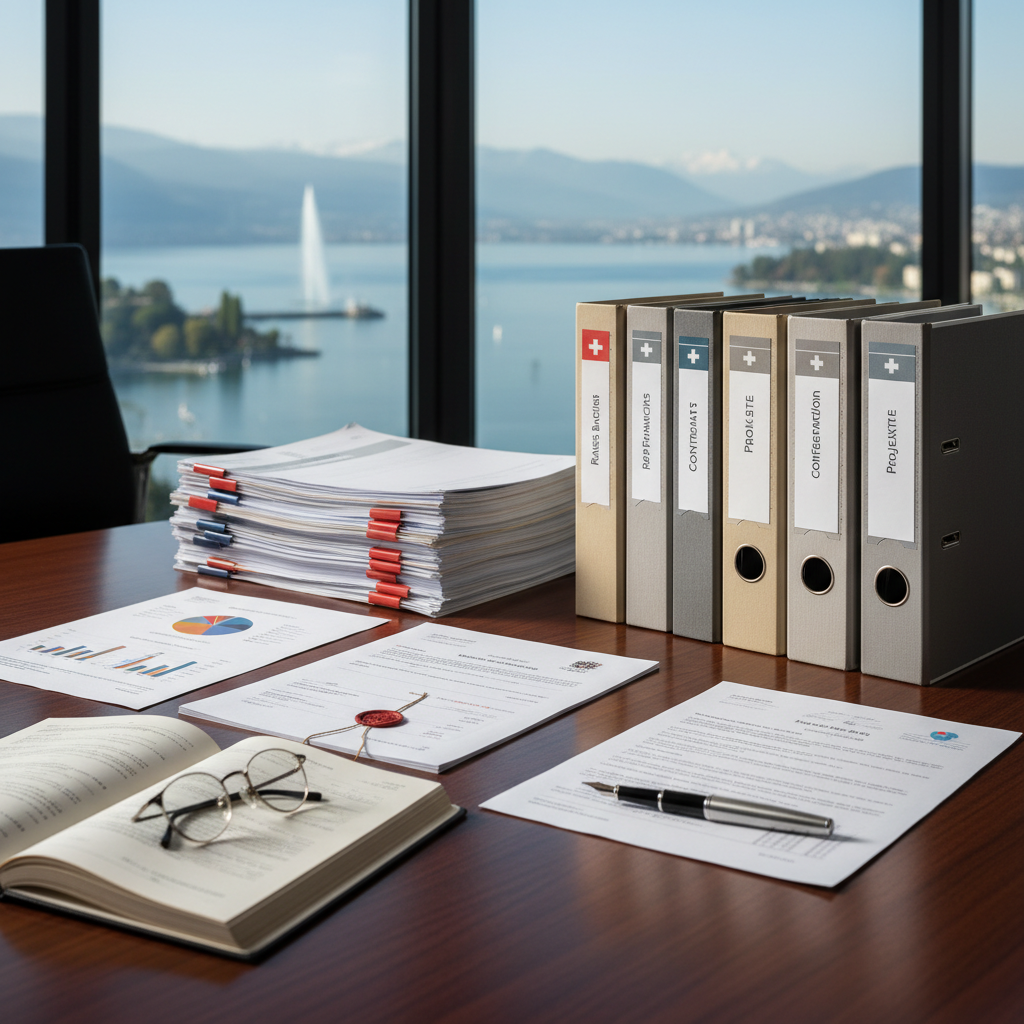
Which Documents Should You Prepare to Sell Your SME in French-speaking Switzerland?
Before meeting a buyer, you gain by presenting a complete, well-organised file. This article sets out the checklist of documents to gather to sell your SME in French-speaking Switzerland: financial statements, key contracts, legal documents, tax, human resources, operations and intellectual property. A structured file speeds up due diligence, strengthens your credibility with a direct acquirer such as Vendre-Entreprise.ch and secures your transaction. Stance: neutral, practical, direct-sale oriented.
Why a complete sale file changes everything
Selling an SME in French-speaking Switzerland cannot be improvised. Even before you meet a potential buyer, the quality of your presentation file largely determines what happens next. A serious acquirer — whether an individual entrepreneur, an industrial group or a financial investor — will systematically ask to see specific documents before committing.
A well-prepared file sends a strong signal: that of a rigorous business owner, a well-run company and a transaction with every chance of closing quickly. Conversely, gaps in the documentation slow down due diligence, raise doubts and weaken your negotiating position.
Here is the complete checklist of documents to gather to sell your SME in French-speaking Switzerland under the best conditions.
Financial documents: the backbone of your file
The numbers speak first. A buyer wants to understand the company's real profitability, its ability to generate cash and the strength of its balance sheet. It is on this basis that they will formulate an acquisition offer.
The financial statements to provide
- Annual accounts for the last 3 to 5 financial years: balance sheet, income statement, notes
- Auditor's report or report of the audit body, where applicable
- Interim accounts (if the sale takes place mid-year)
- Financial plan or budget forecast over 2 to 3 years
- Historical cash flow statement
- Details of financial debt: bank loans, leasing, bonds
- Statement of trade receivables and trade payables
Also consider preparing a restated income statement to highlight normalised EBITDA: owner's remuneration, non-recurring expenses, benefits in kind. This exercise in transparency is often decisive in justifying your valuation.
Legal and statutory documents
An acquirer needs a clear view of the legal structure of the company they are about to take over. Legal documents allow them to check that the company is in good standing and that there are no hidden disputes or constraints.
Constitutional documents and official registers
- Up-to-date articles of association of the company (SA or Sàrl)
- Recent extract from the Commercial Register (RC)
- Share register or register of company shares
- Minutes of general meetings for the last 3 years
- Minutes of the board of directors, if applicable
- Internal organisational regulations, if any
Current contracts and commitments
- Significant client contracts (with any change-of-control clauses)
- Strategic supplier and subcontractor contracts
- Commercial lease and inventory of fixtures
- Finance lease or leasing contracts
- Partnership, distribution or franchise agreements
- Guarantees and sureties granted or received
In particular, identify contracts containing a change-of-control clause (change of control). Some business partners have the right to terminate their contract in the event of a sale. Better to know before the negotiation.
The company's tax position
Tax is a major point of attention for any buyer. They will want to make sure they are not inheriting tax disputes or debts owed to the authorities.
- Latest tax returns filed (profit and capital tax)
- Certificate from the cantonal tax administration confirming the absence of debts
- VAT returns for the last 3 years
- Certificate from the FTA (Federal Tax Administration) for VAT
- Any tax agreements (rulings) concluded with the administration
- Position on tax losses carried forward
In a sale of company shares or stock, the acquirer takes over the company's tax history. They will therefore pay particularly close attention to these elements.
Human resources: an often underestimated asset
In an SME, employees are often the main value driver. A buyer will want to know who they are dealing with and what social obligations they are taking on.
HR documents to prepare
- Anonymised list of employees with role, seniority and salary
- Employment contract templates in use
- Applicable collective labour agreements (CLA)
- Staff regulations, if any
- Certificates from the AVS/AHV compensation fund (absence of debts)
- Pension fund (LPP/BVG) contract and regulations
- Position on untaken holidays and overtime
- Any management contracts with key executives
Some employees hold skills or client relationships that are critical to business continuity. An informed buyer will seek to secure their retention, sometimes through retention clauses.
Operational and commercial elements
Beyond the numbers, an acquirer wants to understand how the company actually works: how it generates its revenue, how it is organised and what its competitive advantages are.
- Commercial presentation of the company (activities, markets, positioning)
- List of main clients with corresponding revenue (anonymised at first)
- List of strategic suppliers and purchasing terms
- Inventory of tangible assets (machinery, vehicles, stock, IT equipment)
- Description of key processes and internal organisation
- Licences, administrative authorisations and professional accreditations
- Company organisation chart
If your business depends heavily on one or two major clients, anticipate the question: a buyer will want to know whether these relationships are contractualised and sustainable. This is a point that can significantly influence the valuation.
Intellectual property and intangible assets
In many SMEs, a significant share of the value rests on invisible assets: brands, know-how, software, patents or client portfolio. These elements must be documented and clearly identified.
- Trademark registration certificates (IPI – Swiss Federal Institute of Intellectual Property)
- Registered patents and utility certificates
- Copyright on software or specific creations
- Domain names and associated rights
- Software licences (proprietary or open source)
- Confidentiality agreements signed with third parties (NDA)
Check that these assets are held by the company and not personally by the owner. This is a common mistake in small businesses that can block a transaction.
Organising your file like a professional
Once the documents have been gathered, their organisation matters as much as their content. Serious buyers appreciate a structured, indexed file that is easy to navigate. In practice, a virtual data room — a secure online sharing space — is used to transmit documents confidentially.
Here is a recommended filing structure:
- 01 – General presentation: sale memorandum, history, organisation chart
- 02 – Financial documents: accounts, budgets, cash flow
- 03 – Legal documents: articles of association, register, general meeting minutes
- 04 – Contracts: clients, suppliers, lease, partnerships
- 05 – Tax and social security: returns, AVS/AHV and LPP/BVG certificates
- 06 – Human resources: staff list, standard contracts
- 07 – Intellectual property: trademarks, patents, domains
- 08 – Operations: assets, licences, processes
Before opening the data room, have every buyer sign a confidentiality agreement (NDA). This step is non-negotiable to protect your sensitive information.
Selling directly: an advantage when the file is ready
Preparing a complete file takes time — allow several weeks depending on the size and complexity of your company. But this investment always pays off: it speeds up due diligence, reduces back-and-forth with the buyer and strengthens your credibility in the negotiation.
When you go through a specialised platform such as Vendre-Entreprise.ch, a well-put-together file allows you to approach the transaction from a position of strength, with no unnecessary intermediary between you and the acquirer. A direct SME sale benefits from impeccable documentation: it builds confidence, smooths exchanges and paves the way for a signing under good conditions.
In French-speaking Switzerland, the business transfer market is active but demanding. Qualified buyers often have several files running in parallel. A complete, well-presented sale file is your best argument for capturing their attention — and keeping it until the transaction closes.
On the same topic
The complete Seller's Guide: valuation, steps, tax and due diligence, written for owner-managers of French-speaking Swiss SMEs.
Read the Seller's Guide